PROGRAMS
Come learn with us
Our programming offers opportunities to explore the intellectual and cultural resources of the Christian tradition through stand-alone events, multi-week reading groups, as well as more sustained communities of intellectual and moral formation for students and faculty.
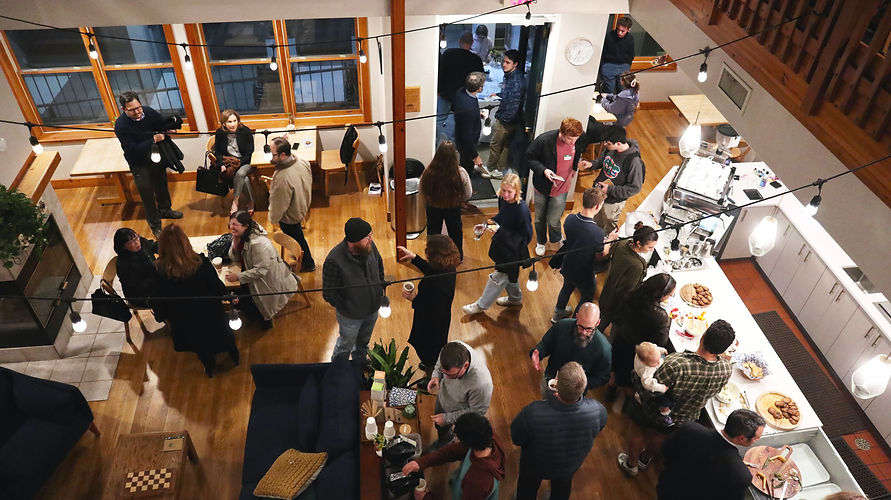
All of our programs embody our commitment to hospitality, generous conversation, and the integration of faith and life.

Classes
Guest Lectures
Reading Groups

Symposium Reading Group
Dr. Nathan Rothschild
Thursdays, July 9 - August 6 | 11:45 AM -12:35 PM
CSC Classroom
Plato’s Symposium weaves together themes of love, transcendence, and the power of beauty to change our lives for the better. We will spend five weeks reading Plato’s dialogue in the attempt to better understand what Plato has to say about these topics as well as explore how they embody a conception of human beings as essentially aspiring (or, as Plato would put it, “erotic”) creatures. We will also spend some of our time thinking about the figure of Socrates, since, in addition to being a dialogue about love, Symposium is also a dialogue about loving Socrates. In addition to Symposium, this group will read an excerpt from Jonathan Lear’s The Concept of Irony.
About the facilitator:
Nathan Rothschild did his PhD work at the University of Chicago and was briefly a post-doc at Bowdoin College before coming to the University of Florida. He is a specialist in Ancient Greek and Roman Philosophy, whose main interest is in philosophical psychology which he understands as an intersection of metaphysics and ethics. The philosophers he cares about most are Plato, Aristotle, and Heidegger. He also has a deep respect for the psychoanalytic tradition of depth psychology. Currently, he is working on Plato’s account of thumos (narcissism) and concept of intra-psychic persuasion. One day he hopes to be able to write a book on Plato’s belief that all desire is erotic.

The Odyssey Reading Group
Michael Sacasas
Mondays, May 11 - June 15 | 11:45 AM - 12:35 PM
Christian Study Center Classroom
Along with the Iliad, the Odyssey profoundly shaped the moral and religious imagination of classical civilization. Its influence persisted throughout the Christian era; Dante's encounter with Odysseus is one of the most famous episodes in the Inferno. Even today, the Odyssey inspires new translations and film adaptations. Join us for five weeks this summer as we read the Odyssey together and consider why it has remained such a timeless and engaging story. Like others before us, we will do so, in part, by reading the story of Odysseus as a story about a universal human longing, the longing for Home, a reading which frames our life as a quest in search of this elusive Home and in which hospitality plays a critical role.
This group will meet weekly on Mondays from May 11 to June 15 (with the exception of May 25) at 11:45am in the Study Center classroom.
About the facilitator:
Michael Sacasas earned his MA in Theological Studies from Reformed Theological Seminary in 2002. He was later a doctoral candidate at the University of Central Florida studying the relationship between technology and society with a focus on the work of Hannah Arendt. He currently serves as a Senior Fellow with the Trinity Forum, an Associate Fellow in Ethics and Culture at the Greystone Theological Institute, and is a contributing editor for Comment Magazine. His writing on technology and the moral life has appeared in The New Atlantis, Comment, The Point Magazine, and Plough.

Till We Have Faces Reading Group
John Mark Vondruska and Ethan Williamson
Mondays, July 6 - August 3 | 11:45 AM - 12:35 PM
Christian Study Center Classroom
How does one love without an end? C.S. Lewis’s retelling of the myth of Cupid and Psyche lingers long on this question. Till We Have Faces masterfully interweaves human fallibility against the silent and mysterious workings of a higher power––all while staying true to the glittering ferocity of the Bronze Age. Join us as we plumb the depths of this hauntingly beautiful text and explore what Lewis’s last novel has to say about being human.
This group will meet weekly on Mondays from July 6 to August 3 at 11:45am in the Study Center classroom.
About the facilitators:
Ethan Williamson received his PhD in history from UF in spring 2025. His specializations include medieval Christianity, Byzantine history, and teaching world history. He is a passionate educator who is currently teaching as a postdoctoral fellow with the University Writing Program at UF. Ethan is also involved in religious education and teaching catechism at St. Elizabeth the Wonderworker Greek Orthodox Church.
John Mark is a wrapping up his last Summer as a Barista Fellow and is going into his first year in the Hamilton School’s MA in Intellectual History. He also unofficially lives at Pascal’s and enjoys deeply the conversations and coffee contained within the place where his imagination was baptized.
Special Events

"Magnificent Humanity": A Conversation About AI and Faith
A panel moderated by Mike Sacasas
Thursday, June 4 at 7:00 PM
Christian Study Center
Reception | 7PM
Panel | 7:30PM
The evening will include an ecumenical panel moderated by Executive Director, Mike Sacasas. Continue reading to learn more about our panelists.
Mike Sacasas (Moderator)
Executive Director, Christian Study Center of Gainesville
Mike Sacasas earned his MA in Theological Studies from Reformed Theological Seminary in 2002. He was later a doctoral candidate at the University of Central Florida studying the relationship between technology and society with a focus on the work of Hannah Arendt. He currently serves as a Senior Fellow with the Trinity Forum, an Associate Fellow in Ethics and Culture at the Greystone Theological Institute and is a contributing editor for Comment Magazine. His writing on technology and the moral life has appeared in The New Atlantis, Comment, The Point Magazine, and Plough.
Ana Siljak, PhD
Associate Professor of Humanities, University of Florida Hamilton School
Dr. Ana Siljak received her PhD in History from Harvard University and was a professor of history at Queen’s University until 2023. Her most recent publications include her edited volume entitled Religion and Secular Modernity in Russian Christianity, Judaism, and Atheism (Cornell University Press, 2024) and her edition of the translation of the correspondence of Nikolai Berdyaev and Jacques Maritain entitled An Exceptional Dialogue, 1925–1948: Nikolai Berdyaev and Jacques Maritain (McGill-Queen’s University Press, 2025). She is currently a co-author of the textbook, Visions of the West, to be published by Oxford University Press in 2026. She is currently completing her book on the personalist philosophy of Nikolai Berdiaev.
Lillian King Abadal, PhD
Visiting Assistant Professor of Instruction, University of South Florida
Dr. Lily Abadal completed her doctorate under the mentorship of Thomas Williams at the University of South Florida, focusing on the history of medieval philosophy and virtue ethics. Lily has presented original research at the American Academy of Religion’s annual conference, The New College Conference for Medieval and Renaissance Studies, Notre Dame’s Center for Ethics and Culture, and numerous other academic conferences. She maintains an interest in history of medieval philosophy but has also begun developing several ideas in applied virtue ethics, particularly in healthcare and medicine.
Christopher Hampson, JD, MTS
Associate Professor of Law, University of Florida Levin College of Law
Professor Hampson is an award-winning scholar of bankruptcy, insolvency, and the ethics of debt. His research focuses on how legal institutions can best serve our shared values during times of financial distress. Professor Hampson earned an A.B. from Harvard College in the comparative study of religion, magna cum laude with highest honors, a J.D. from Harvard Law School, magna cum laude, and an M.T.S. from Harvard Divinity School, where he was a Dean’s Fellow. During his time at Harvard Law School, he served as Articles Co-Chair of the Harvard Law Review. He has written on a wide range of topics, from social enterprises and small businesses to debtors’ prisons and harsh debt collection practices. His scholarship has appeared or is forthcoming in prominent law reviews across the country, including the Harvard Law Review, the Iowa Law Review, the Boston University Law Review, the Fordham Law Review, the American Bankruptcy Law Journal, and the Journal of Free Speech Law.
Walker Percy Fellows Program
Walker Percy Fellows pursue the integration of faith, life, and learning during their undergraduate years. The program combines readings in the Christian tradition, fellowship around shared meals, and rich conversations to foster a community of intellectual and spiritual formation.
The 2025-2026 cohort will begin meeting this fall for Year One of the curriculum focused on the cultivation of the Christian Mind. During this year, students will receive a grounding in the biblical story and in a Christian understanding of the pursuit of knowledge and wisdom.
Applications for the 2026-2027 cohort are now open.


